
How to Change to Plant-Based Eating
How do you change over from your current way of eating to plant-based?
Here are some simple tips to follow:
- Use the Traffic Light model developed by Dr Greger — and detailed in his book “How Not to Die”.
- Remember BALANCE is key: all food groups play a role in a healthy diet.
- Consider your protein options — there are many.
- Carbs (the unprocessed ones!) are also important.
- Fats —which ones are better (green light) than others (amber/red light).
- Do not count calories.
- Do exercise as part of this new lifestyle.
- Look for interesting recipes.
- Plan a basic menu.
- Make a shopping list.
Go plant-based in 3 easy steps:
STEP 1
TRAFFIC LIGHT MODEL

Use this as a guide to plant-based eating.
Aim to eat this way 80% of the time.
| Definition | Why? | Daily foods | Number of servings/day | |
|---|---|---|---|---|
| GREEN LIGHT = GO! EAT MORE | Unprocessed plant foods Nothing bad added, nothing good taken away | These foods have MORE of the protective nutrients and FEWER of the disease-promoting factors | Legumes* Berries Other fruits Cruciferous vegetables Green vegetables Other vegetables Flaxseeds Nuts Spices Whole grains Water Exercise | 3 1 3 1 2 2 1 1 1 3 6-8 glasses 1 |
| AMBER LIGHT = CAUTION EAT FEWER | Processed plant foods And Unprocessed animal foods | Suggested role of these foods: to promote the consumption of Green-light foods, e.g. having oats porridge (green-light) with almond milk OR having legumes with a little tomato sauce | Examples: Refined grains (white flour, mealie meal, white rice) Almond milk (almonds are green light) | |
| RED LIGHT = STOP EAT EVEN FEWER | Ultra-processed plant foods And Processed animal foods | Suggested role of these foods: to promote the consumption of Green-light foods | Examples: Packet sauces Box foods Sweets |
The main point is that the healthiest diet is one that maximizes the intake of whole plant foods and minimizes the intake of animal-based foods and ‘junk” foods (high on sugar and/or salt and/or cholesterol and/or trans fats).
*Legumes include soybeans, chickpeas, lentils, butter beans, kidney beans and many many more. SOYA should be a fundamental component of your DAILY diet due to its phytonutrient component and the fact that it is the only legume that it is a COMPLETE PROTEIN.
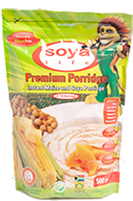
Soya Life has 3 products that make incorporating soya easy:
- Soya Life Premium Porridge 500g
- Soya Life Breakfast Porridge 1kg
- Soya Life Instant Meal Replacement Drink 500g
Look out for these in Dischem.
Tips:
- Don’t be obsessive: try not to adopt an “all-or-nothing” approach to this way of eating, as this could potentially set you up for failure.
- Remember that foods are not so much “good” or “bad” as they are “better” or “worse”.
- Make this practical and tasty for YOU and YOUR FAMILY – see steps 2 and 3.
- Adding salt to food takes it into the Amber- and Red-light zones.
- Allow yourself a favourite food (e.g. pizza) once a month or on special occasions.
STEP 2
LOOK FOR INTERESTING RECIPES
- Google WHOLE-FOOD, PLANT-BASED recipes OR buy a South African vegetarian/vegan recipe book. Always check if the recipes REALLY appeal to you, otherwise search further!.
- Another tip: on Google, type in the ingredients (green-light) that you have in your pantry and find recipes for these ingredients, e.g. spinach, chickpeas, tomato, whole-kernel corn. These ingredients could be made into a delicious curry or even a salad with a few select spices/condiments.
STEP 3
PLAN A SIMPLE MENU
- Choose 3 recipes that appeal to you for your MAIN MEAL of the day.
- Rotate these 3 recipes until you get the hang of plant-based basics. And then find more recipes.
- Plan breakfasts (Soya Life porridge/oats) and the light meal with easy options.
- Develop a standard shopping list. This will change over time as you become more in tune with this way of eating.
Enjoy the plant-based cooking adventure – Your body will thank you.
References and acknowledgements:
Dr M. Greger: “How Not to Die”: this book is highly recommended reading.
Comments are closed.